
IPPNY Encourages Doubling Down on Prohibition of Utility-Owned Generation to Protect New Yorkers
Independent Power Producers of New York, Inc. (IPPNY) today submitted detailed comments to the New York State Public Service Commission strongly advising the Commission to reaffirm its long-standing policy prohibiting utility ownership of electric generation. Allowing monopoly utilities to own generation would only increase costs and risks for captive ratepayers, at a time when 71% of New Yorker’s say that their utility bills have increased, according to a survey of over 800 likely voters. Undermining competitive electricity markets and slowing the State’s clean energy progress is not the answer.
The competitive wholesale electricity market has protected New Yorkers from utility monopoly cost overruns for over 25 years. Independent generators have significantly lowered power supply costs, reduced emissions, and pay over $1.5 billion annually in property taxes, lifting surrounding communities up. Shifting generation investment risk from private developers to utility customers would be a step backwards and would significantly weaken climate progress and innovation.
“Competition has been the cornerstone of New York’s electric system for decades, and it has delivered real results for New Yorkers,” said Gavin Donohue, President and CEO of IPPNY. “Utilities already have a long history of cost overruns and allowing them back into the generation business would put ratepayers back on the hook for those costs, as well as construction delays, and operating inefficiencies. Furthermore, allowing utility monopolies to own generation would distort market competition and raise the cost of achieving the State’s clean energy goals.”
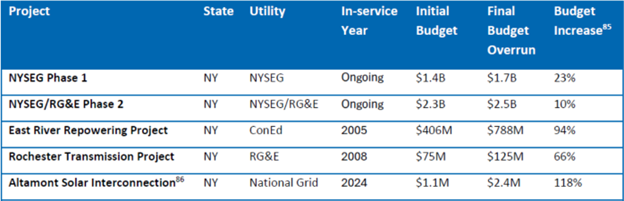
A 2025 study by FTI Consulting exposed numerous examples of cost overruns from utility monopolies, directly shifting exorbitant costs to captive ratepayers. Unlike privately invested independent power producers, utilities do not have the financial incentives to complete projects on time and at least cost, allowing for cost overruns and additional profits to be passed onto consumers.
Below are examples of egregious cost overruns on utility projects in New York, as shown in FTI’s analysis:
Allowing utility-owned generation would also tilt the playing field. Utilities would have built-in advantages over private developers, including preferred access to grid infrastructure and prime locations, making it harder for independent companies to compete and invest in New York. There is no suitable alternative method, such as build transfer, that would alleviate all the harm this encroachment into utility-owned generation would cause.
“New York’s clean energy transition does not require dismantling competitive markets or reintroducing utility monopolies into generation,” Donohue added. “It requires market-based solutions that attract private investment, paired with sensible regulatory standards. The reality is, New York is competing with other states and countries for economic opportunities. Reversing long-standing policy would send the wrong message and cause New York to lose out on billions of dollars in private investment.”
As an alternative to utility-owned generation, the Commission should focus on reforms through the New York Independent System Operator’s stakeholder process, which include targeted capacity market enhancements. These approaches would efficiently reduce emissions, preserve electric reliability, and maintain the proper allocation of financial risk between investors and consumers. Additionally, having resources diverted from transmission and distribution duties to generation deployment will only overextend the utilities, causing delays in critical transmission projects.
Doubling down on the Commission’s long-standing policy against utility-owned generation is recognizing that wallet-strapped New Yorker’s should not have to choose whether to pay their electric bill or have enough food on the table. Competition has proven to work for more than two and a half decades and now is not the time for a drastic policy change that will cause significant harm.